Travel to Tanzania
At dawn in the Serengeti the plains go quiet for a moment before the herds start to move. A few hours later you can be standing on the rim of the Ngorongoro Crater, and by the end of the week watching dhows sail past Stone Town. Few countries pack this much into one trip.
Tanzania has the Serengeti and the Great Migration, the Ngorongoro Crater, Tarangire’s elephant herds and the tree-lined shores of Lake Manyara. It has Mount Kilimanjaro, Africa’s highest mountain at 5,895 meters, which you can climb without technical skills. And it has the islands: Zanzibar with its spice farms and Swahili old town, and quieter Mafia Island for diving and whale sharks.
Most trips combine a safari in the north with a few days on the coast. Here’s how a Tanzania safari compares to Kenya, and how to plan a budget safari in Tanzania.
Our travel tips below are sorted by place and by what you want to do: Zanzibar, Serengeti, Mount Kilimanjaro, Safaris and National Parks, Things to Do and See, Outdoor and Nature and General Travel Tips.
Visa Requirements for Tanzania
Most visitors from outside East Africa need a visa. The easiest way is the eVisa at visa.immigration.go.tz: apply at least three weeks before you travel and keep the approval with you. A single-entry tourist visa costs $50, and US citizens pay $100 for a multiple-entry visa. A single-entry visa is also available on arrival at the main airports and borders, but the queues can be long.
New since 1 October 2026: all visitors to mainland Tanzania need the government’s inbound travel insurance, $44 for adults and $22 for children aged 3 to 17. Zanzibar has required the same $44 policy since October 2024. One policy covers a trip to both, so buy it for the place where you first arrive, online before you travel or on arrival. Your own travel insurance does not replace it.
Your passport must be valid for at least six months after arrival. A yellow fever vaccination certificate is required if you arrive from a country with yellow fever risk, and Kenya is on that list, so carry it if you combine a Kenya and Tanzania safari.
General travel tips for Tanzania
Important Cultural Information
Swahili and English are the official languages. A few words of Swahili are always welcome: jambo or habari for hello, asante for thank you and karibu, which you will hear everywhere and means welcome.
Greetings matter in Tanzania, so say hello before you ask a question, and keep calm and polite even when things take longer than planned. Public displays of affection are frowned upon. Zanzibar is mostly Muslim: dress modestly away from the beach, especially in Stone Town, as tourists can be fined for inappropriate clothing in public. Ask before you photograph people, including the Maasai you meet on safari.
Mainland Tanzania banned plastic carrier bags in 2019, and bags are collected at the airport, so pack in reusable bags. Clear zip-lock bags for toiletries are fine.
Banking & Money in Tanzania
The currency is the Tanzanian shilling (TZS). US dollars are widely accepted for safaris, park fees, lodges and on Zanzibar, but bring clean notes printed in 2006 or later, as older or damaged notes are often refused.
ATMs are found in towns and cities but are rare in the countryside, so withdraw cash before you head to the parks. Larger hotels and lodges accept Visa and Mastercard, often with a surcharge. Mobile money, such as M-Pesa, is used everywhere by locals.
Medical Emergency Information
The emergency number for police, fire and ambulance is 112. Outside Dar es Salaam and Arusha, medical care can be basic, so make sure your travel insurance covers evacuation, especially for safaris and a Kilimanjaro climb.
Malaria is present in most of Tanzania, including Zanzibar, so see a travel clinic about antimalarials and vaccinations at least eight weeks before you go. Altitude sickness is a real risk on Kilimanjaro: here is the best time to climb and what to pack.
If you’re looking for travel insurance, we are an affiliate of SafetyWing, a travel medical insurance provider.
Read as well: What is a Travel Insurance? And why you need it.
Wi-Fi and Internet in Tanzania
Most hotels, lodges and cafes in towns and on Zanzibar have Wi-Fi, and many safari camps have it in the main area, though it is often slow. Some of the best hotels in Zanzibar include it for free.
For data, buy a local SIM at the airport (you need your passport) or an eSIM before you go. Vodacom has the widest coverage, and Airtel is a good alternative. The internet has been restricted during protests in the past, so keep offline maps and copies of your bookings on your phone. Make sure to set up a VPN (like ExpressVPN) before using public Wi-Fi.
Arrival in Tanzania
Tanzania has three main international airports: Kilimanjaro International (JRO) between Arusha and Moshi, the best choice for a northern safari or a Kilimanjaro climb; Julius Nyerere International (DAR) in Dar es Salaam; and Abeid Amani Karume International (ZNZ) on Zanzibar. Many travelers fly in via Nairobi, Addis Ababa, Doha, Dubai or Istanbul.
You can search for flights to Tanzania on Expedia.
Overland, the busiest border crossing is Namanga between Nairobi and Arusha, served by daily shuttle buses. From Dar es Salaam, fast ferries reach Zanzibar in about one to two hours.
Areas of Tanzania
Tanzania is big, so most visitors focus on one or two regions per trip.
Serengeti and the Northern Circuit
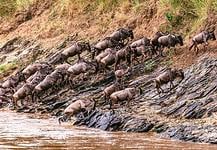
The classic safari route starts in Arusha and links Tarangire, Lake Manyara, the Ngorongoro Crater and the Serengeti. The Great Migration moves through the Serengeti all year: calving on the southern plains around February, river crossings in the north from about July. Here’s the best time to visit the Serengeti, how to get there from Arusha and why a balloon safari is worth the early start.
Travel tips for the Serengeti
Mount Kilimanjaro
Africa’s highest mountain rises to 5,895 meters above Moshi. Routes such as Machame, Lemosho and Marangu take five to nine days, and longer routes give you more time to acclimatize. You don’t need climbing experience, but good preparation makes the difference. Read about climbing Kilimanjaro as a non-climber.
Travel tips for Mount Kilimanjaro
The South and the West
Nyerere National Park (formerly part of the Selous) and Ruaha see far fewer visitors than the north, with boat safaris, walking safaris and big lion and elephant populations. In the far west, Gombe and Mahale on Lake Tanganyika are known for chimpanzee trekking. In the Udzungwa Mountains you can hike through rainforest full of endemic species, like the tree frog found nowhere else.
Dar es Salaam, Dodoma and the Coast
Dar es Salaam is the largest city and main port, and the jumping-off point for Zanzibar and Mafia Island. Dodoma is the capital, with the parliament and most ministries, while Dar remains the business and travel hub. South of Dar, the coast is quiet, with marine parks and long empty beaches.
Transportation in Tanzania
On safari, most travelers move with an operator and a driver-guide in a 4×4 with a pop-up roof. Distances are long and many park roads are gravel, so small planes are popular: bush flights connect Arusha, the Serengeti airstrips, Zanzibar and the southern parks.
Long-distance buses link the main towns, and dala-dalas (minibuses) are the cheap local option. The new electric SGR train runs between Dar es Salaam and Dodoma in about three and a half hours. Fast ferries connect Dar es Salaam and Zanzibar several times a day. Tanzanians drive on the left, and driving at night outside towns is best avoided.
Accommodations in Tanzania
On safari you choose between permanent lodges, tented camps and seasonal mobile camps that follow the migration. Tented camps range from simple to very comfortable, with proper beds and en-suite bathrooms under canvas, and are the best way to hear the bush at night.
On Zanzibar you’ll find everything from guesthouses in Stone Town’s old houses to beach resorts in Nungwi, Kendwa and Paje. Book early for the dry season from June to October and the Christmas holidays. Search for accommodation at Booking.com and Expedia.
What to Eat and Drink in Tanzania
Tanzanian food is simple and filling. Try nyama choma (grilled meat), ugali (stiff maize porridge), wali wa nazi (coconut rice), chipsi mayai (a chips omelet), mishkaki (meat skewers) and mandazi, a slightly sweet fried bread. On the coast, Swahili cooking brings coconut and spices: try prawn curry, octopus and the Zanzibar pizza at Forodhani’s night market.
Zanzibar is known as the spice island for its cloves, nutmeg, cinnamon and vanilla, and a spice tour is worth half a day. To drink, there is chai (spiced tea), coffee from Kilimanjaro’s slopes and local beers such as Kilimanjaro and Safari.
Safaris and National Parks in Tanzania
Tanzania protects a large share of its land in national parks, game reserves and conservation areas. The northern circuit is the most popular, with five parks worth the drive: Serengeti, Ngorongoro, Tarangire, Lake Manyara and Arusha. Park fees are charged per person per 24 hours, so they add up on a longer safari.
The dry season from June to October is the easiest time for game viewing, while January and February bring the calving season in the southern Serengeti. Planning a special trip? See our ideas for a honeymoon in Tanzania.
Safaris and national parks in Tanzania
Things to Do and See in Tanzania
Beyond the game drives, Tanzania has plenty to fill a trip. For a longer list, see our things to do in Tanzania.
- Climb Kilimanjaro – or hike Mount Meru and the crater rim of Ngorongoro if you want something shorter.
- Ngorongoro Crater – a full day inside a collapsed volcano with lions, rhinos and flamingos.
- Olduvai Gorge – one of the most important sites for early human fossils, between Ngorongoro and the Serengeti.
- Stone Town – a UNESCO World Heritage Site, best explored on foot with a guide.
- Snorkeling and diving – around Mnemba, Pemba and Mafia Island, where whale sharks visit from about October to March.
- Nungwi – dhow builders, turtles and sunsets, see things to do in Nungwi.
Things to do and see in Tanzania
Shopping in Tanzania
Look for Tinga Tinga paintings, Maasai beadwork, kangas and kikoi cloth, carvings and Zanzibar spices. Tanzanite, a gemstone found only near Arusha, is sold everywhere, but buy it only from certified dealers with a certificate. Haggling is normal at markets.
In Stone Town, the Darajani Market and the craft shops of the old town are the best places to browse, and here are the best markets in Stone Town. In Arusha, the Maasai Market and the Shanga workshop, which employs people with disabilities, are worth a visit. Don’t buy products made from shells, coral or animal skins: exporting them needs a permit.
Tanzania’s Nightlife
Nightlife on the mainland is centered on Dar es Salaam’s bars and clubs and the hotel bars of Arusha. On safari, evenings mean a fire, dinner and an early night.
Zanzibar is livelier, with beach bars and parties in Nungwi, Kendwa and Paje, especially around the full moon. Here’s all you need to know about Zanzibar nightlife.
Safety Tips for Tanzania
Tanzania is generally safe for visitors, and the safari areas and Zanzibar see millions of travelers without problems. In Dar es Salaam, Arusha and Stone Town, watch out for pickpockets and bag snatchers, use registered taxis or ride-hailing apps after dark and don’t carry valuables openly.
Book safaris and Kilimanjaro climbs with licensed operators and never pay large sums to touts on the street. Avoid demonstrations, and don’t photograph protests or government buildings. Some areas close to the Mozambique border are covered by travel warnings, so check your government’s travel advice before you go.
Conclusion
Tanzania is one of the best places in the world for a first safari, and it doesn’t stop there. Add a climb up Kilimanjaro, a few days in Stone Town or a week on the beaches of Zanzibar, and you have a trip that covers far more than game drives.
Start with the best time to visit the Serengeti, sort out your visa and insurance, and leave room for a few slow days by the Indian Ocean.