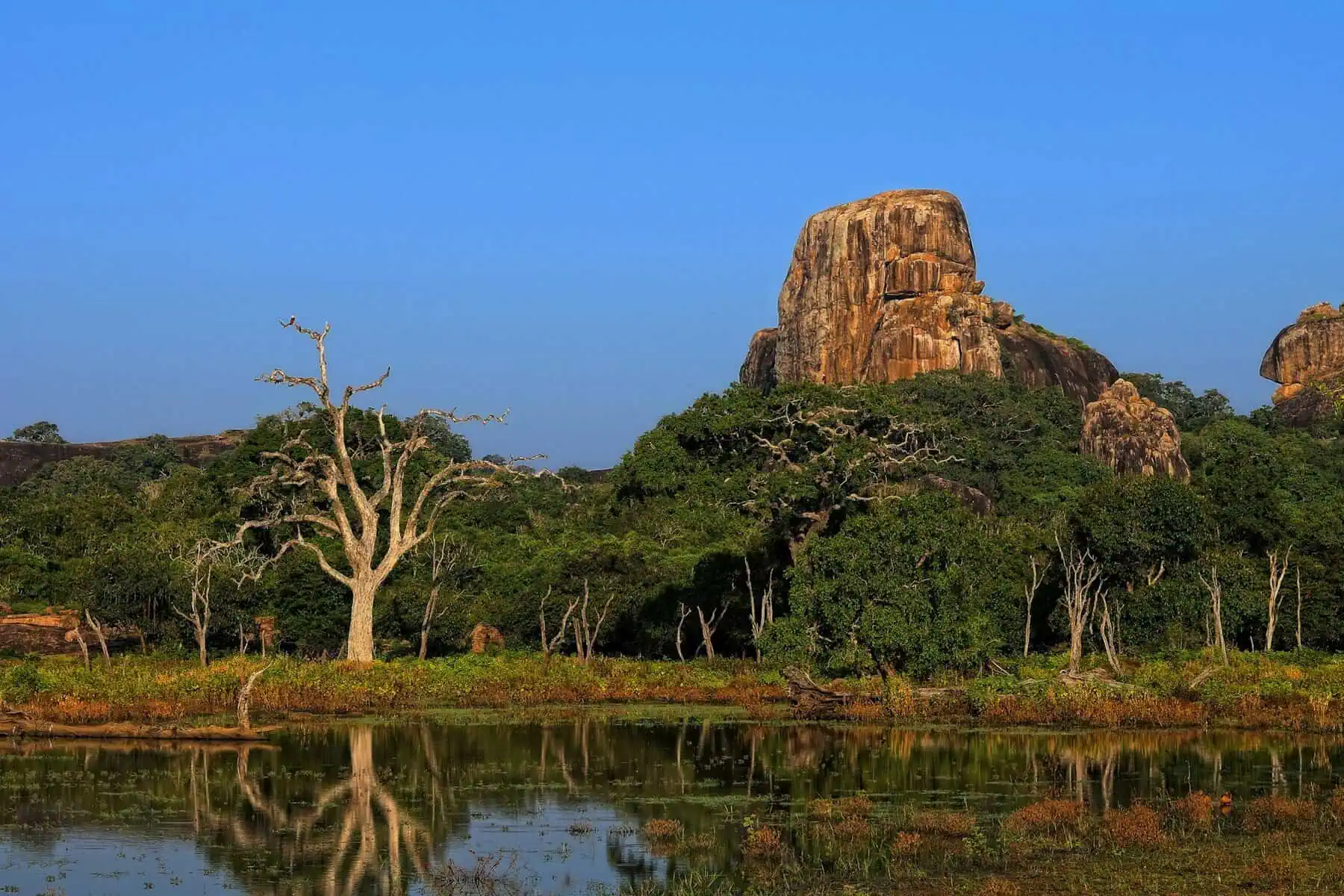
Wildlife safaris in Sri Lanka put you in an open jeep watching elephants, leopards and birds in their natural habitats, with time for photographs and for the warm hospitality of the island’s people along the way.
The country has numerous national parks, nature reserves, safari lodges, and camps waiting to be explored. Managed by the Department of Wildlife Conservation, Sri Lanka has more than two dozen national parks, and more than ten of them cover over 100 square kilometers. Even Lahugala-Kitulana National Park, one of the smaller ones at about 16 square kilometers, provides an important sanctuary for iconic species such as leopards, sloth bears, and elephants.
Most parks—except for Flood Plains—are open to the public for jeep safari tours. Many of the larger parks have bungalows, campsites or both. However, overnight stays can be relatively expensive due to the fees set by the Wildlife Department.
Related read: How to See Leopards in Sri Lanka in the Wild
Here’s your guide to the best national parks for wildlife safaris in Sri Lanka.
- Best National Parks for Wildlife Safaris in Sri Lanka
- Yala National Park
- Wilpattu National Park
- Udawalawe National Park
- Bundala National Park
- Kumana National Park
- Minneriya National Park
- Gal Oya National Park
- When Is the Best Time to Visit Sri Lanka’s National Parks?
- Featured Tour: Sri Lanka Wildlife Safari Tour (13 Days)
- Trip Highlights
- Itinerary Overview

Best National Parks for Wildlife Safaris in Sri Lanka
Yala National Park
Sri Lanka is blessed with remarkable natural beauty and some of the world’s most remarkable wildlife. Among its many treasures, Yala National Park stands out as one of the country’s premier destinations for nature and wildlife enthusiasts. As Sri Lanka’s second-largest national park, Yala is a true source of national pride and a sanctuary for countless species.
Efforts to protect Yala’s diverse wildlife have helped preserve its most iconic residents—majestic leopards, tusker elephants, and a dazzling array of bird species, particularly waterbirds that glide gracefully across the park’s wetlands.
Covering an impressive 979 square kilometers, Yala lies about 300 kilometers from Colombo in the Southern and Uva Provinces. The park’s landscapes are wonderfully varied, with freshwater and marine wetlands, scrublands, and lush monsoon forests. It has recorded 215 bird species and 44 mammals, and it has one of the highest leopard densities in the world. Reptiles, amphibians, and freshwater fish also thrive in this rich ecosystem.
Yala sits among several other renowned parks, including Bundala, Udawalawe, and Lunugamvehera. Within its borders are two important pilgrimage sites, Sithulpahuwa and Magul Vihara, adding cultural significance to its natural wonders.
The park is divided into five distinct blocks, with four entrance points open to visitors. Of these, the Palatupana entrance to Block 1 is by far the most popular, and most safaris start there.
Related read: Best Day Trips From Colombo

Wilpattu National Park
Wilpattu National Park is Sri Lanka’s largest national park and one of its oldest, celebrated as one of the best places in the world to see the Sri Lankan leopard in the wild. Its vast wilderness shelters a wide variety of wildlife, including 31 species of mammals such as the mighty Sri Lankan elephant, the elusive leopard, the endangered sloth bear, and the graceful spotted deer.
The park is particularly famous for providing rare opportunities to spot both leopards and sloth bears in their natural habitats. With fewer than 1,000 individuals left in the wild, the Sri Lankan sloth bear is considered endangered, making a sighting here especially meaningful.
Wilpattu is also known for its “Villus”, natural lakes scattered throughout the park. These wetlands are vital for sustaining both resident and migratory waterbirds, adding to the park’s rich biodiversity and distinct landscape.
The best way to explore Wilpattu’s rugged beauty is on a 4WD open-top safari, where experienced guides can lead you to the park’s most wildlife-rich areas.

Udawalawe National Park
Udawalawe National Park, the third most visited park in Sri Lanka, is a favorite among both locals and tourists. Located near Yala National Park, it was originally established to provide a sanctuary for wildlife displaced by the construction of the Udawalawe Reservoir on the Walawe River.
Covering 308 square kilometers, Udawalawe was officially declared a national park on 30 June 1972. Situated about 165 km from Colombo, it is best known for its thriving population of Sri Lankan elephants and its abundance of water birds.
The park’s open grasslands and scrub jungles support a rich diversity of flora and fauna, making it an excellent place to spot not just elephants and birds, but also reptiles, fish, and other wildlife. For visitors seeking a close-up experience with Sri Lanka’s gentle giants in their natural habitat, Udawalawe is the park to choose.

Bundala National Park
Bundala National Park is famous for the large flocks of flamingos that migrate through the area each year. This coastal sanctuary is rich in biodiversity, with waterfowl, large water birds, Asian elephants, leopards, wild boar, and graceful spotted deer.
Recognized internationally as a vital wintering ground for migratory waterbirds, Bundala is especially beloved by birdwatchers. It was declared a national park in January 1993, when it covered about 62 square kilometers. Its boundaries were redrawn in 2004.
Located about 245 km southeast of Colombo, Bundala draws visitors from around the world eager to see its coastal wetlands and birdlife. For anyone passionate about wildlife photography or birdwatching, this park is an unmissable stop in Sri Lanka.

Kumana National Park
Kumana National Park, located in southeastern Sri Lanka, covers 18,149 hectares and is one of the country’s premier eco-tourism destinations. Famous as a bird sanctuary, it is especially renowned for its rich diversity of birdlife.
The park’s defining feature is Kumana Villu, a 200-hectare natural swamp lake fed by the Kumbukkan Oya through a narrow half-mile channel. Each year, during May and June, the swamp becomes a busy nesting ground for thousands of water birds, including spoonbills, pelicans, and white ibis. Birdwatchers may also be lucky enough to spot the rare black-necked stork.
In addition to its avian residents, Kumana has several mammals also found in nearby Yala National Park, such as elephants and leopards. Its landscape features mangroves, kumbuk, and karan trees, interspersed with open marshlands.
For anyone passionate about birdwatching or nature photography, Kumana National Park is worth the long drive.

Minneriya National Park
Minneriya National Park, also known as Minneriya Safari Park, is one of Sri Lanka’s most popular wildlife destinations for both families and adventure seekers. Covering 8,890 hectares, the park includes the former Minneriya-Giritale Sanctuary, parts of the Minneriya-Giritale Nature Reserve, and the Sigiriya Sanctuary. Located in Polonnaruwa District in the heart of the island’s Cultural Triangle, Minneriya is world-famous for “The Gathering”, when hundreds of wild elephants congregate around the Minneriya Tank during the dry season. It is widely regarded as one of Asia’s great wildlife events.
Recognized as one of Sri Lanka’s 70 Important Bird Areas (IBAs), Minneriya is also a haven for birdwatchers. During the dry season, elephants from the Matale, Polonnaruwa, and Trincomalee districts migrate here, making it the perfect time for close encounters with these gentle giants.
Ecologists consider Minneriya a vital part of Sri Lanka’s dry-zone ecosystem, playing a key role in the long-term conservation of elephants and other displaced wildlife. The park is surrounded by several other protected areas—including Wasgomuwa, Kaudulla, Somawathiya, and Flood Plains National Parks—creating a vast, interconnected habitat for wildlife.
Easily accessible via the Habarana–Polonnaruwa highway, Minneriya promises an extraordinary safari experience and a chance to watch the Gathering for yourself.

Gal Oya National Park
No Sri Lankan safari is complete without spending time observing the majestic Asian elephant in its natural habitat. Imagine being surrounded by the park’s wilderness when, suddenly, an elephant emerges quietly from the bushes. It strolls to the water’s edge, lowers its trunk for a drink, and playfully splashes the water, a simple reminder of nature’s resilience and grace. Moments like these stay with you forever.
Gal Oya National Park is especially famous for its elephants, known as some of the best swimmers among all mammals. These gentle giants effortlessly traverse the park’s lush, green islands, one of the most unusual wildlife sights in Sri Lanka. Watching a massive elephant swim gracefully from one island to another is an experience that words can hardly capture.
Despite their immense size, Gal Oya’s elephants radiate a quiet tranquility. Seeing them emerge from the water, towering and powerful, stays with you. This is a place where you don’t just observe nature; you feel deeply connected to it.
Give Gal Oya at least a full day if you want to see the elephants cross the water.

When Is the Best Time to Visit Sri Lanka’s National Parks?
The best time to visit most of Sri Lanka’s national parks is between April and August, when wildlife sightings are plentiful and tourist numbers are generally lower, making for a more peaceful safari experience.
Sri Lanka’s climate is shaped by two monsoon seasons that arrive from opposite directions at different times of the year. Thanks to this weather pattern, at least half of the country is usually suitable for travel at any given time, and most national parks remain open year-round (with only brief seasonal closures in some cases). Yala’s main blocks usually close for several weeks between September and October, so check the dates with the Department of Wildlife Conservation before you book.
Average daytime temperatures sit in the mid-20s°C, occasionally reaching up to 35°C. The humidity can make it feel warmer, but visitors can always find relief in the cooler hill country or along breezy coastal areas.
The southwest monsoon brings rain to the south, west, and central highlands from May to September, while the northeast monsoon affects the north and east from December to February. The dry season typically falls between December and March in the southwest and May to September in the northeast. Even in the so-called “dry” months, brief showers are common—but sunny days are never far behind.
Related read: Top Places to Visit in Sri Lanka

Featured Tour: Sri Lanka Wildlife Safari Tour (13 Days)
Join a 13-day wildlife safari across Sri Lanka’s most iconic and biodiverse locations, where lush rainforests meet vast national parks and pristine coastlines. This journey is perfect for nature lovers and wildlife enthusiasts, offering up-close encounters with the island’s unique flora and fauna in their natural habitats.
From misty rainforests and tropical jungles to sprawling savannas and dolphin-filled waters, each day promises a new adventure and a deeper connection to Sri Lanka’s extraordinary wilderness. This immersive tour combines jeep safaris, nature walks and wildlife watching, showcasing the country’s rich ecosystems—from rainforests and savannas to serene beaches and marine life.
Trip Highlights
- Sinharaja Rainforest – Trek through Sri Lanka’s UNESCO-listed rainforest, home to endemic birds, exotic plants, and abundant wildlife.
- Yala National Park – Experience thrilling jeep safaris in the park with the world’s highest leopard density, along with elephants, sloth bears, and diverse birdlife.
- Udawalawe National Park – Discover one of the best places in Asia to see wild elephants, with its vast herds and scenic landscapes.
- Kitulgala & Makandawa Rainforest – Immerse yourself in lush rainforest surroundings, perfect for birdwatching and nature walks along the Kelani River.
- Habarana – Explore tranquil lakes and spot elephants and other wildlife in this beautiful part of Sri Lanka’s Cultural Triangle.
- Kalpitiya Dolphin Watching – Witness playful spinner dolphins in pristine coastal waters, adding a marine touch to your wildlife journey.
- Negombo – End your adventure by relaxing on scenic beaches and exploring historic Dutch canals.
Itinerary Overview
Day 1: Arrival in Colombo
Day 2–3: Explore Sinharaja Rainforest
Day 4: Travel to Yala National Park
Day 5: Full-day safari in Yala
Day 6: Transfer to Udawalawe National Park
Day 7: Travel to Kitulgala
Day 8: Discover Makandawa Rainforest
Day 9: Transfer to Habarana
Day 10: Travel to Kalpitiya
Day 11: Dolphin watching in Kalpitiya
Day 12: Transfer to Negombo
Day 13: Departure from Colombo
Ceylon Travel Dream plans wildlife safaris across Sri Lanka’s national parks with local guides. Tell them your dates and which parks you have in mind, and they will put together a trip that fits:
Ready to plan your dream safari? Ceylon Travel Dream can customize this itinerary, or create an entirely new one, based on your preferences for destinations, wildlife experiences, and pace of travel.