Travel to the Democratic Republic of the Congo
The Democratic Republic of the Congo is the second-largest country in Africa, and most of it is forest and river. The Congo River curves through the whole country, Kinshasa spreads along its banks across from Brazzaville, and the central basin holds the largest share of the second-largest tropical rainforest on Earth. It is the only country where bonobos live in the wild, and the east has mountain gorillas and volcanoes.
To see what a trip into the forest looks like, read where the Congo Basin goes quiet and the bonobos appear, a guided canoe expedition from Kinshasa into Équateur and Tshuapa. Our DR Congo travel tips below cover entry rules, safety advice, money and planning.
Entry Requirements for DR Congo
Most visitors, including travelers from the US, the UK and Germany, need a visa for the DRC. Apply in advance through a Congolese embassy and allow two to three weeks, as some applications are referred to Kinshasa. The German Foreign Office says visas are not issued at the border or the airport, and that an online eVisa is available only for stays of up to seven days, at a higher fee. Your passport must be valid for at least six months after you arrive.
A yellow fever vaccination certificate is an entry requirement for all travelers aged nine months and older, so carry it with your passport. On departure, international passengers pay an exit fee of 55 US dollars, known as the Go-Pass. Satellite phones, GPS devices and military-style clothing can cause problems at customs.
Safety and Travel Advice for DR Congo
Official travel advice for the DRC is strict and changes often, so read it before you book and again before you fly. As of November 2026, the UK Foreign Office advises against all travel to North Kivu, South Kivu, Ituri, Haut-Uélé, Maniema, Tanganyika, Haut-Lomami, parts of Mai-Ndombe and the area within 50 km of the border with the Central African Republic. The US State Department advises travelers to reconsider travel to the DRC and lists North Kivu, Ituri, South Kivu, Tanganyika, Haut-Lomami and the three Kasai provinces as do not travel areas.
The German Foreign Office has a travel warning for Ituri, North and South Kivu, Haut-Lomami, Maniema, Mongala, Tanganyika, Tshopo, North and South Ubangi, Bas-Uélé, Haut-Uélé and the north of Haut-Katanga, and advises against non-essential travel to the rest of the country, including Kinshasa. The UK and German advice also report an Ebola outbreak that the WHO declared a public health emergency of international concern in May 2026, so check the current health and entry information before you go.
Consular help is limited outside Kinshasa, and travel against official advice can invalidate your travel insurance. Check the current advice on gov.uk, travel.state.gov or auswaertiges-amt.de. If you’re looking for travel insurance, we are an affiliate of SafetyWing, a travel medical insurance provider.
Money in DR Congo
The official currency is the Congolese franc (CDF), but US dollars are used for most larger payments in the cities, including hotels, tours and flights. Bring clean, undamaged dollar notes printed in 2013 or later, as older notes and 1 dollar bills are often refused. Keep some francs for small purchases, markets and taxis.
Cards work only in a few places, mainly large hotels, some supermarkets and airline offices. ATMs exist in the bigger cities, with daily limits, so plan to carry enough cash for the whole trip outside Kinshasa. Amounts over 10,000 US dollars must be declared on arrival, and Congolese francs cannot be taken out of the country.
Getting There and Around
International flights land at N’djili International Airport (FIH) in Kinshasa, east of the city center. The road from the airport into town is slow, and the German Foreign Office advises against using it after dark.
The country is huge and the road network is thin. Many roads need a 4×4 and become impassable in the rainy season, so long distances are covered by plane or by boat. Most Congolese airlines are on the EU Air Safety List, which bans them from EU airspace. Check the list before you book a domestic flight.
The ferry across the Congo River between Kinshasa and Brazzaville, capital of the Republic of the Congo, links two capitals that face each other across the water. Other public river ferries are considered unsafe, so for river and forest trips, travel with an experienced operator who arranges boats, permits and guides, as on this Congo River expedition from Kinshasa. A train runs between Kinshasa and the port of Matadi about twice a week.
Regions and Highlights of DR Congo
Kinshasa
The capital is one of the largest cities in Africa, loud and music-driven, with the Congo River at its edge. Lingala and French are the languages you’ll hear most. Lola ya Bonobo, a sanctuary on the outskirts, cares for orphaned bonobos rescued from the bushmeat and pet trade and has returned some of them to the wild.
The Congo Basin Rainforest
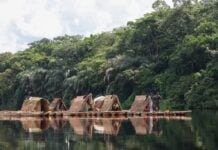
The central basin, in provinces such as Équateur and Tshuapa, is where guided expeditions go by dugout canoe along tributaries of the Congo River to watch bonobos, look for signs of forest elephants and visit river villages. Salonga National Park, the largest tropical rainforest reserve in Africa, protects a large part of the bonobos’ range and is a UNESCO World Heritage site.
Kongo Central
West of Kinshasa, the Congo River drops through a series of rapids on its way to the Atlantic. The province has waterfalls such as the Zongo Falls, and the port city of Matadi near the river mouth.
Eastern DR Congo
The east is where Virunga National Park, the oldest national park in Africa, protects mountain gorillas and the Nyiragongo volcano, and where Kahuzi-Biega National Park protects eastern lowland gorillas. Both parks lie in North and South Kivu, where the UK, US and German governments currently advise against all travel. Read our gorilla trekking in the DRC article for how gorilla visits work.
Watching Wildlife in DR Congo
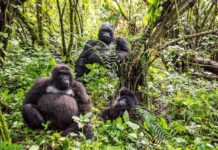
Bonobos live in the wild only in the DRC, in the forests south of the Congo River. On a guided trip you watch them from the canoe or the trail at a distance, quietly, while they feed and rest, and sightings are never guaranteed. Never touch, feed or follow the animals, keep your voice down and follow your guide’s signals. The same applies to gorillas, forest elephants and monkeys.
Food and Drink in DR Congo
Congolese food is built on cassava, plantains, river fish and leafy greens. Try pondu, cassava leaves cooked down with palm oil and often smoked fish, and moambe, chicken in a palm nut sauce. Fufu and chikwangue, a dense cassava bread wrapped in leaves, come with most meals. Liboke is fish or meat steamed in banana leaves over the fire.
On the river, grilled fish with cassava, plantains and fruit like mango and pineapple is the everyday meal in villages. In Kinshasa, order a cold Primus, the best-known local beer.
Best Time to Visit DR Congo
The Congo Basin is warm and humid all year, usually between 24°C and 32°C, with frequent tropical showers. Kinshasa and the south have a drier season from about June to September, when roads are easier and the heat is less heavy. North of the equator, the drier months are roughly December to February. Expect rain at any time in the rainforest.
Planning Your Trip to DR Congo
Most travelers combine a few days in Kinshasa with one guided expedition into the Congo Basin, which takes about a week on its own because of the long transfers. Book through an operator who knows the region you want to visit and arranges permits, transport and local guides, and build in spare days, as flights and river schedules shift.
Pack light long-sleeved clothing, a rain jacket, insect repellent, dry bags and binoculars. Check the official travel advice, your visa, your yellow fever certificate and your cash plan before you leave.