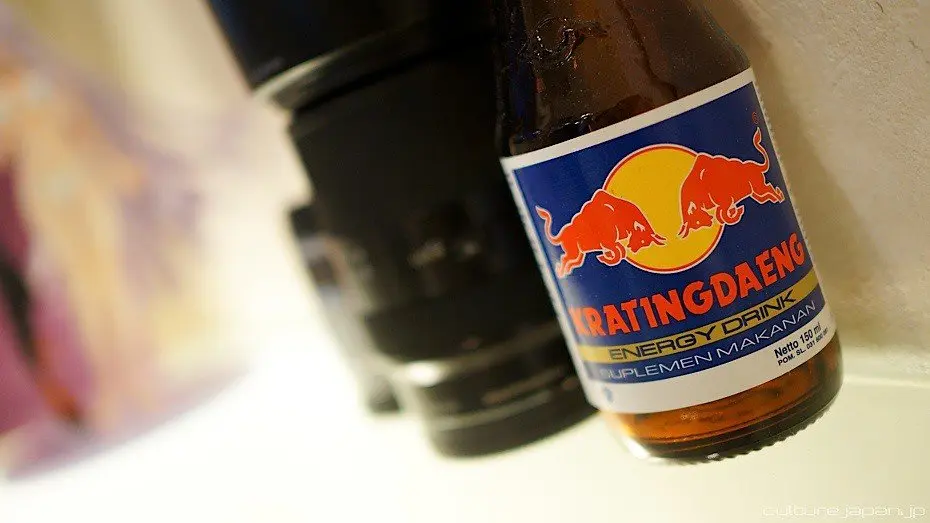
Red Bull is one of the world’s best-known energy drinks. But did you know that the original Thailand Red Bull is Krating Daeng?
The small can that offers to “give you wings” has been fueling dare devils on its way to becoming the worlds largest sponsor of extreme sports.
Motocross, snowboarding, freestyle skiing, rally racing to bobsledding….
Red Bull has proved it supports those athletes it aims for as customers. The name itself has become synonymous with action sports.
Most people believe it was invented by a man from Austria named Dietrich Mateschitz. Actually it was concocted by a man in Thailand named Chaleo Yoovidhya. Used by truckers to stay alert – some early customers even believed it contained natural aphrodisiacs from bull testicles!
What Is Thai Red Bull?
The original name is Krating Daeng
Krating Daeng was introduced to Thailand in 1976 by the ethnic Chinese entrepreneur Chaleo Yoovidhya. Krating is a reddish colored type of bovine while daeng means red. Easily translated to Red Bull. Only later was it westernized by the Austrian to European tastes. Sweetened, carbonated and repackaged. A deal struck between the Thai and Austrian that would later become an energy drink behemoth.
The Krating Daeng logo underlies its branding, with two charging bulls representing power, red signifying perseverance, and the backdrop of the sun symbolising energy.

Drinking Red Bull in Thailand
The original Thailand Red Bull still exists in Thailand today and boy does it pack a wallop! Per 100 ml it carries about the same caffeine as the Red Bull sold in the US, but it is sweeter and more syrupy. It comes in a small glass bottle about two times the size of a nip. It is not carbonated and differs in taste greatly.
Certainly not meant to be consumed in one sitting, but rather small sips over time to keep you alert. Concentrated non~carbonated and killer kick. I made the mistake of drinking half a bottle after I had a coffee. Within 30 minutes I was off the wall. Hands shaking, jittery doesn’t even begin to describe it. An hour later I was fine. Lesson learned.
The next few days I used it sparingly, pulling swigs here and there throughout the day whenever I was getting sluggish.
Overall I liked the Thailand Red Bull.
After I ignorantly nearly OD’d on the stuff I figured I would share my warning with everyone if you are over in Thailand and in need of a boost and want to try something different.
Energy drinks are hugely popular in Thailand, where they are sold in near-identical bottles for small change, usually well under a dollar, at 7-Eleven outlets, corner shops and kerbside kiosks. Their advertising is targeted at low-paid workers working long hours, including taxi, tuk-tuk, truck and bus drivers, and construction workers.
If you want to try it yourself, you can also buy it on Amazon, so you don’t need to go all the way to Thailand to get your fix.
How Much Caffeine Is in Thai Red Bull?
A 150 ml bottle of Krating Daeng contains 50 mg of caffeine. That is also the legal ceiling in Thailand, where the Food and Drug Administration allows no more than 50 mg per bottle or can, according to TCP Group, the company that makes the drink. A 250 ml can of Red Bull Energy Drink contains 80 mg, according to Red Bull.
So one bottle of Thai Red Bull carries less caffeine than one can of the Red Bull you know from home. Measured per 100 ml, the two are almost level at about 33 mg and 32 mg. What sets the Thai original apart is the sugar, the syrupy texture and the missing bubbles.
Here is how that compares with other drinks. The coffee, tea and soft drink figures are the typical amounts the US Food and Drug Administration lists for a 12 fl oz (355 ml) serving.
- Krating Daeng, 150 ml bottle: 50 mg
- Red Bull Energy Drink, 250 ml can: 80 mg
- Regular brewed coffee, 355 ml: 113 to 247 mg
- Black tea, 355 ml: 71 mg
- Caffeinated soft drink, 355 ml: 23 to 83 mg
Frequently Asked Questions
Is Krating Daeng the same as Red Bull?
No. Krating Daeng is the Thai original from 1976. The Red Bull sold in Europe and the US is the later version made for Western tastes, carbonated and sold in a can. The two names mean the same thing.
Is Thai Red Bull stronger than regular Red Bull?
Not by the numbers. A 150 ml bottle has 50 mg of caffeine and a 250 ml can of Red Bull has 80 mg, which works out to nearly the same amount per 100 ml. It tastes heavier, because it is sweeter, syrupy and has no bubbles.
Is Thai Red Bull carbonated?
No. The original Krating Daeng is a still drink that comes in a small 150 ml glass bottle.
Where can you buy Krating Daeng in Thailand?
At any 7-Eleven, corner shop or kerbside kiosk, usually for well under a dollar a bottle. Look for the two charging red bulls on the label.