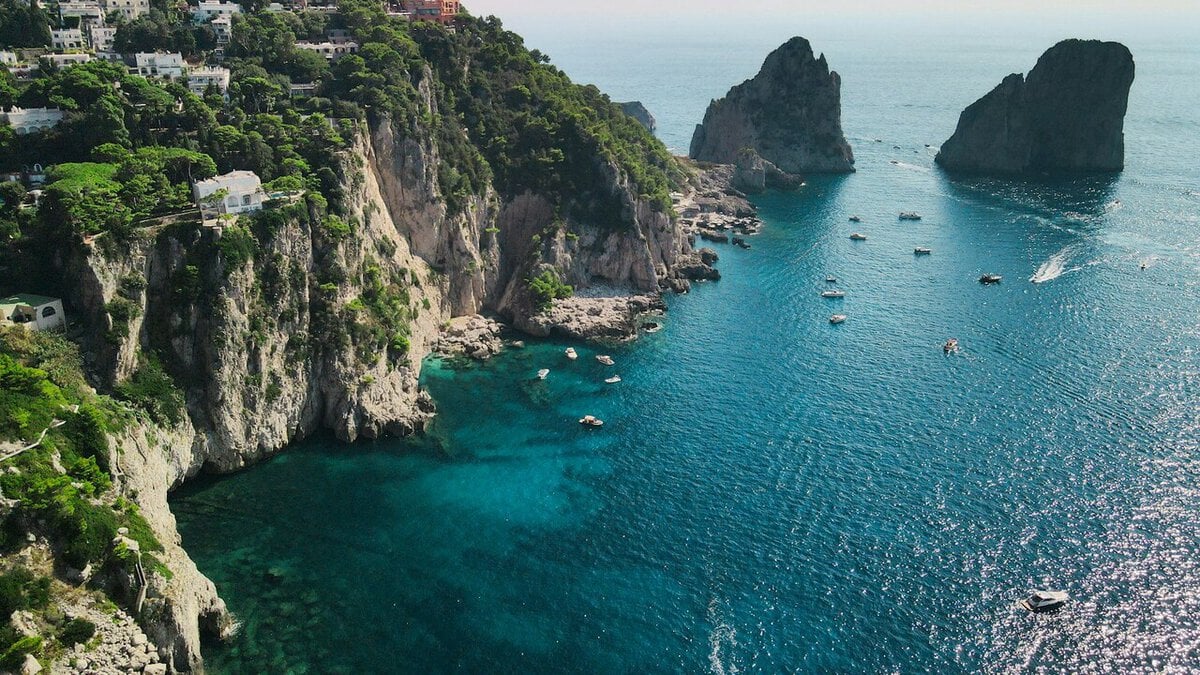
Ask any traveler who has sailed past Capri to name one view that stopped them mid-sentence, and there’s a good chance they’ll describe three rocks rising straight out of the sea. Not a beach, not a piazza, not a sunset over some generic coastline. Three limestone stacks, weathered into shapes that look almost deliberate, sitting in water so clear it barely seems real. That’s the Faraglioni, and once you’ve seen them, they tend to stick around in your memory longer than almost anything else from a Mediterranean trip.
What you’re actually looking at
The Faraglioni aren’t one formation, they’re three, and each has its own name and personality. Stella, the closest to shore, is still attached to the island by a narrow strip of rock and rises over 100 meters straight out of the water. Next comes Faraglione di Mezzo, shorter than Stella but the most photographed of the three thanks to the natural stone arch cut clean through its middle by centuries of waves.
Furthest out sits Scopolo, home to a lizard found nowhere else on Earth: a small blue reptile that has evolved its unusual color here and, as far as anyone knows, only here.
Geologists will tell you the stacks are limestone, shaped over millions of years as the softer rock around them eroded away and left these three giants standing. Locals will tell you a different story: fishermen who say the rocks were fires lit to guide ships home, or that the Faraglioni were once sirens, turned to stone for singing sailors to their deaths. Believe whichever version you like. Either way, standing at a viewpoint like the Gardens of Augustus or looking down from Via Krupp, you start to understand why painters and poets have been obsessing over this exact stretch of coastline for a couple of centuries now.
Why the view matters more than the checklist
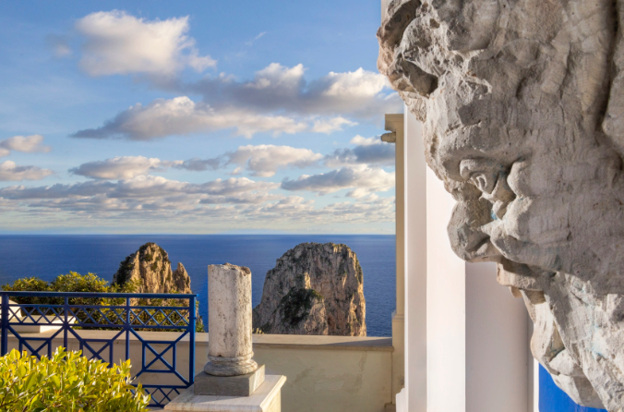
Most people see the Faraglioni for twenty minutes, from a boat, then move on to the Blue Grotto or lunch in the Piazzetta. Nothing wrong with that. But there’s a different way to experience this view, one where it isn’t a stop on an itinerary but the backdrop to your entire stay. That’s the case for anyone who books a luxury villa in Capri like Villa Azzurra, which sits directly above the Faraglioni and treats the view less like scenery and more like a fourth roommate.
The villa’s terraces wrap around both sides of the property, so the Faraglioni are visible from almost everywhere: the living room, the pool deck, even the walk-in shower in the master suite, which looks straight out at the rocks through floor-to-ceiling glass. You wake up to them. You have coffee with them. Dinner on the rooftop terrace happens with the stacks turning gold, then pink, then a deep blue-grey as the sun drops behind them, and there’s a bar up there built specifically for the kind of evening where nobody wants to go back inside.
That constant presence changes how the view registers. A twenty-minute boat pass gives you a great photo. Three days of waking up, swimming, and eating with the Faraglioni always in the corner of your eye gives you something closer to a relationship with the place, one where you start noticing details you’d otherwise miss: the way the light on the rocks shifts hour by hour, the exact moment fishing boats round the outer stack each morning, how different the water looks at 7am versus sunset.
Making the most of it, whether you’re staying or just visiting
If you’re not booking a villa with a private view, you still have good options. The best free vantage points are the Gardens of Augustus, a short walk from the Piazzetta, and Via Krupp, the switchback path carved into the cliff below it (check it’s open before you go, as it closes periodically for maintenance). Marina Piccola gives you a sea-level view and a swim in the same visit. For the classic photo through the natural arch, book a small boat tour rather than one of the bigger group cruises. You’ll get closer, and your captain will actually slow down for the shot instead of powering past with forty other people trying to get the same angle.
If you do have a few days on the island and want the view to be a constant rather than an event, that’s where a stay somewhere like Villa Azzurra earns its price tag. It’s the difference between visiting a view and living inside one, even briefly.
Capri rewards this kind of slower travel generally, and it’s part of a bigger pattern across this stretch of Italian coast, where the water and the light do a lot of the heavy lifting. If you’re building out a longer Italy itinerary and want to see how Capri fits alongside Ischia and the rest of the Amalfi coastline, our guide to adventure travel in Italy covers a multi-day sailing route that strings them together by boat, which is honestly one of the better ways to arrive at the Faraglioni for the first time.
However you choose to see them, give the Faraglioni more than twenty minutes if you can. Some views are worth a photo. This one’s worth a morning coffee, an afternoon swim, and a slow dinner, ideally more than once.