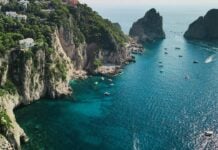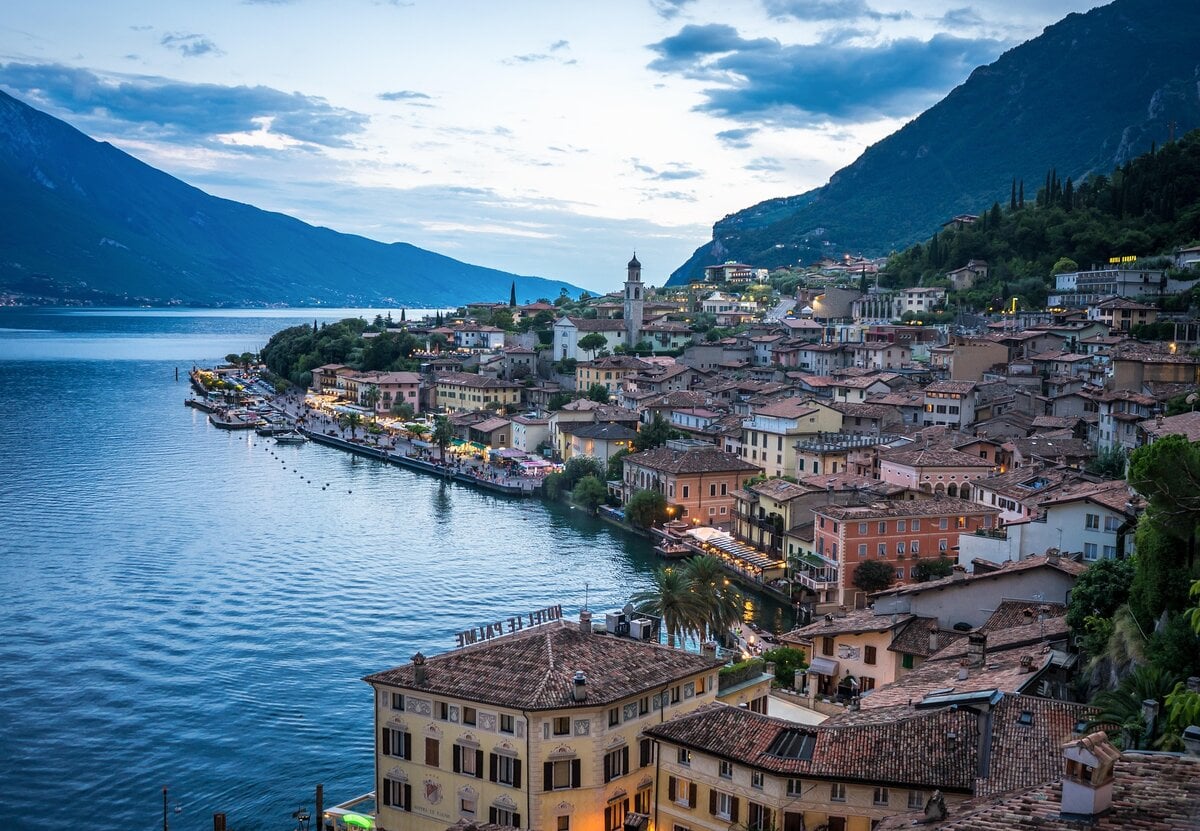
Lake Garda stretches 52 km through three Italian regions, and each one feels like a different country. The southern Lombardy shore has Roman mosaics and high-speed trains to Milan. The eastern Venetian shore has medieval harbor towns, flat cycling paths, and Italy’s largest amusement park within earshot. The northern Trentino tip has cliff-face hiking trails, thermal winds that draw windsurfers from across Europe, and a bike path cantilevered 50 meters above the water.
You can experience all three shores in a single week without a car, the public ferry system connects them in hours, and what holds the trip together is a microclimate mild enough for olive groves and lemon trees at a latitude that has no business growing either.
Those seeking accommodations that combine the independence of a private home with the excellence of hotel services will find an ideal solution by choosing among the best Lake Garda lodges, cutting-edge accommodations designed to offer privacy and comfort in settings of rare beauty.
Here is what you need to know to plan it:
- Lazise and the Eastern Venetian Shore
- Bardolino Wine and Garda Olive Oil
- Where to Stay in Lazise
- Desenzano and the Southern Lombardy Shore
- Sirmione: Roman Ruins and Thermal Springs, 10 Minutes Away
- Dining, Markets, and Where to Stay in Desenzano
- The Northern Trentino Shore: Wind, Cliffs, and Suspended Paths
- The Ciclopista del Garda: Cycling Between Cliff and Lake
- Cliff-Face Hiking and the Monte Baldo Cable Car
- Practical Information
- Getting around the lake
- Best time to visit
- Getting there
- Day trips
- Typical costs
- Frequently Asked Questions
- How many days do you need at Lake Garda?
- Can you get around Lake Garda without a car?
- Is Lake Garda suitable for young children?
- What is the Ciclopista del Garda and is it open?
- Are the thermal baths in Sirmione worth visiting?
- When is the best time to ride the Monte Baldo cable car?
Lazise and the Eastern Venetian Shore
Lazise earned self-governing rights from Emperor Otto II in 983 AD, making it one of the earliest free municipalities in Italy.
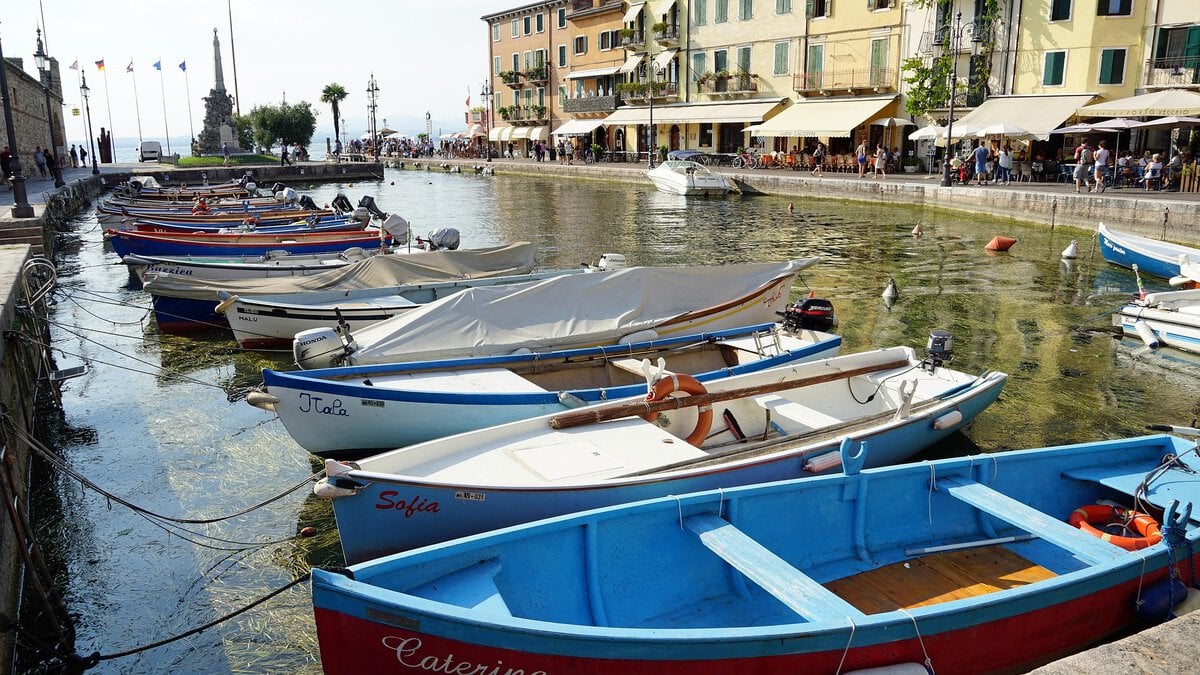
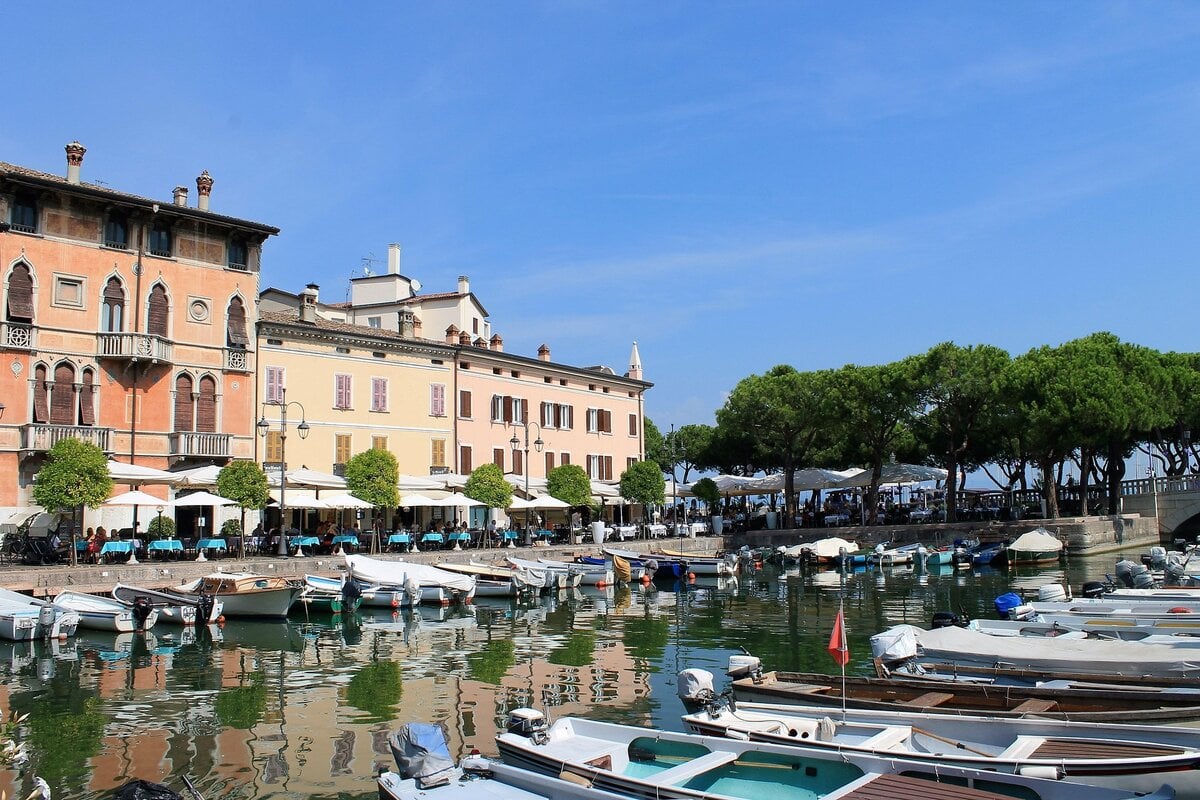
That civic independence shows in its layout: a compact harbor enclosed by 14th-century Scaliger walls, three surviving medieval gates, and the Dogana Veneta — a Venetian customs house on the waterfront that now hosts food and wine festivals.
The Castello Scaligero, rebuilt between 1375 and 1381, is privately owned by the Bernini family and closed to visitors inside, but its exterior walls, towers, and the surrounding park are freely accessible. Porta del Lion still bears the winged Lion of St. Mark from four centuries of Venetian rule.
The eastern shore’s real draw for families and casual cyclists is its flat, asphalted cycling infrastructure. A lakeside promenade path runs roughly 18 km from Peschiera through Lazise, Cisano, and Bardolino to the town of Garda — entirely flat, suitable for strollers, and at its best before 09:00 in summer when the path is quiet and the light on the water is soft. For a longer ride, the Peschiera–Mantova cycle path follows the Mincio River for 43.5 km along a disused railway with just 70 meters of total climbing, connecting to the EuroVelo 7 network. It draws over 200,000 cyclists a year.
Three major theme parks sit within minutes of Lazise.
Gardaland, Italy’s largest amusement park, is 2–4 km away (gate tickets approximately €56 adults, from €49 online; 2026 season 28 March–1 November).
Caneva World in Pacengo di Lazise splits into Movieland, Italy’s only cinema-themed park, and Caneva Aquapark, a water park open late May through mid-September.
Parco Natura Viva, a 42-hectare safari and conservation park 15–20 km away in Bussolengo, houses 1,500 animals across 250 species (€25–30 depending on options).
Free shuttles run from Peschiera del Garda station to Gardaland and Caneva World.
Bardolino Wine and Garda Olive Oil
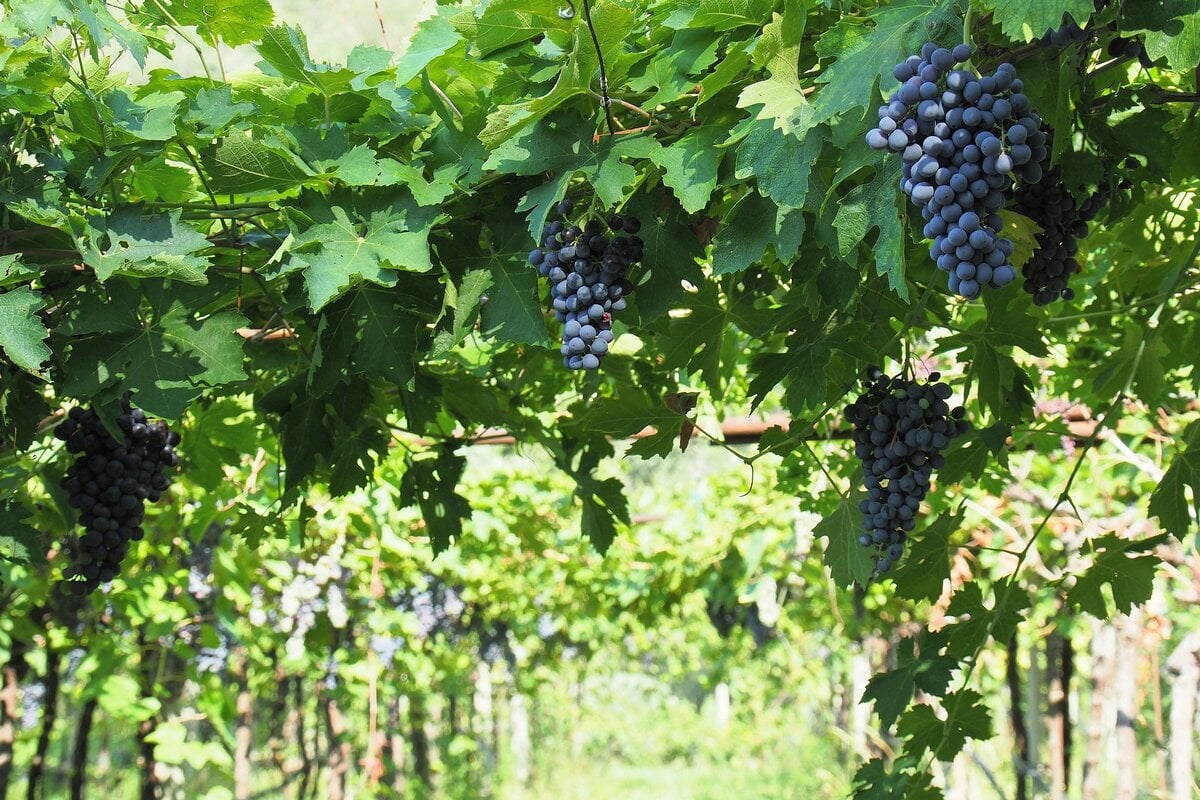
The eastern shore is Bardolino DOC country — one of Italy’s earliest wine designations, granted in 1968. The wines are light-bodied reds and the increasingly celebrated Chiaretto rosé (which earned its own DOC in 2018), made from Corvina, Rondinella, and Corvinone grapes — the same family as Valpolicella, but in a lighter, more immediately drinkable register. Around 100 producers work three sub-zones, yielding over 25 million bottles annually.
Zeni, established in 1870 on the Bardolino lakefront, offers free tastings of six wines and houses a small wine museum. Guerrieri Rizzardi, winemaking since 1649, is worth the detour for its cellars alone.
Garda DOP extra virgin olive oil, protected since 1997, relies on the Casaliva olive variety on this shore. Producers must cold-press within five days of harvest to a maximum acidity of 0.5%, resulting in an oil with a distinctive sweet almond finish. Several historic mills along the eastern shore offer tastings and tours.
Lazise’s weekly market runs every Wednesday, 08:00–14:00, sprawling along the harbor and through the old town. Bardolino’s market is Thursdays. Other nearby markets fill nearly every day: Peschiera on Mondays, Garda on Fridays, Malcesine on Saturdays.
Where to Stay in Lazise
Accommodation on the eastern shore ranges from agriturismo farmhouses in the olive groves above town to lakefront camping villages with modern lodge units.
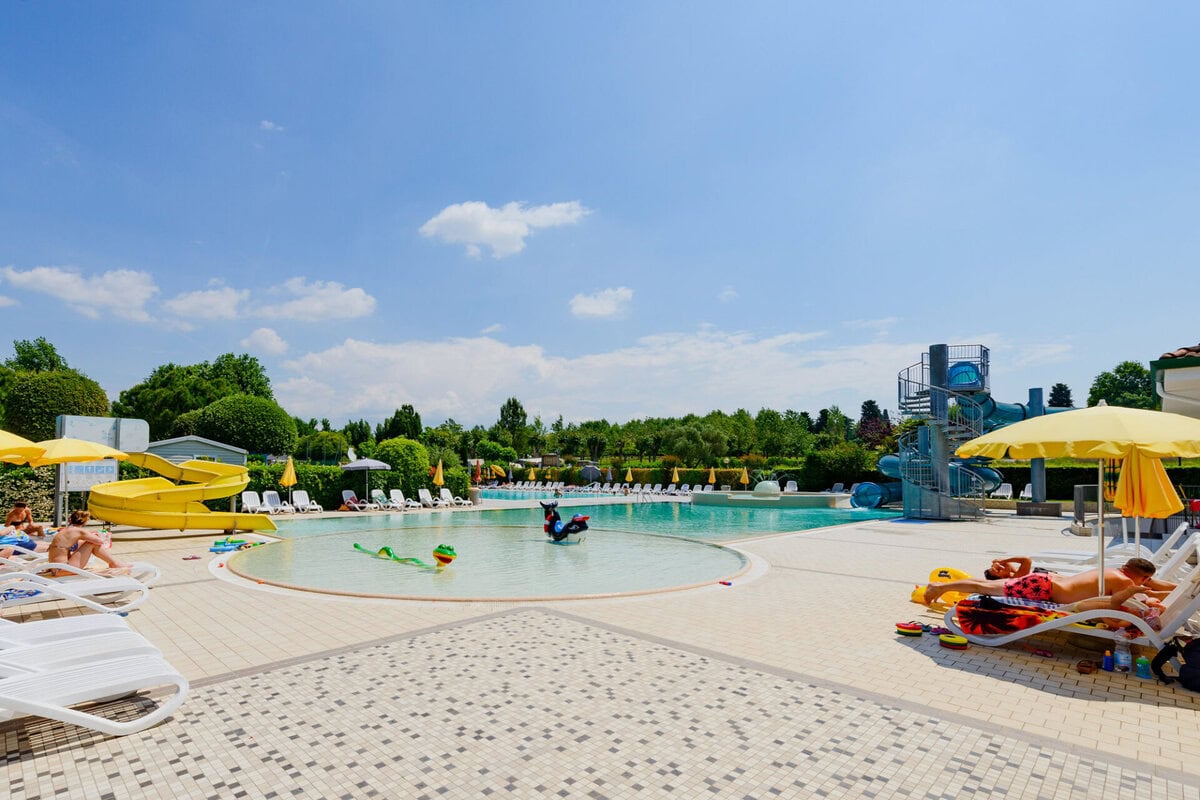
For families looking for a self-contained base with direct lake access, Club del Sole’s Le Palme Lazise Family Collection in Pacengo sits directly on the lakefront, 2 km from Gardaland. The site offers lodges, bungalows, apartments, and camping pitches across a terraced, tree-shaded property with two pools (one is heated and the other one has water slides), a private beach, and a restaurant with a panoramic lake-view terrace. The lodge units feature full kitchens and outdoor living areas — useful for families who want the flexibility to eat in some evenings and dine out others. The season runs from late March to early November.
Desenzano and the Southern Lombardy Shore
Desenzano del Garda is the lake’s best-connected town.
Its train station sits on the Milan–Venice high-speed line: Milan arrives in as little as 50 minutes (from approximately €12), regional trains from Verona take 20 minutes (approximately €5.70), and there are roughly 63 daily departures.
If you’re arriving by air, Verona Villafranca Airport is 30 km east; Milan Bergamo Airport is 80 km west.
The Villa Romana dei Mosaici, discovered accidentally in 1921, preserves some of northern Italy’s finest late-antique polychrome floor mosaics across a site spanning roughly one hectare. Built in phases from the 1st century BC to the 5th century AD, the highlight is a triple-apsed dining hall with vivid hunting scenes and floral compositions. An antiquarium displays ceramics, bronze utensils, and statue fragments recovered from the site.
Open Tuesday–Saturday 09:00–19:30, Sundays until 14:00.
Entry is €6 (reduced €2 for EU nationals aged 18–25, free under 18).
The Castello di Desenzano, perched above the town, offers free access to its grounds and charges approximately €3 for the keep, whose spiral staircase delivers panoramic views south across the Morainic Hills and north to Monte Baldo.
Sirmione: Roman Ruins and Thermal Springs, 10 Minutes Away
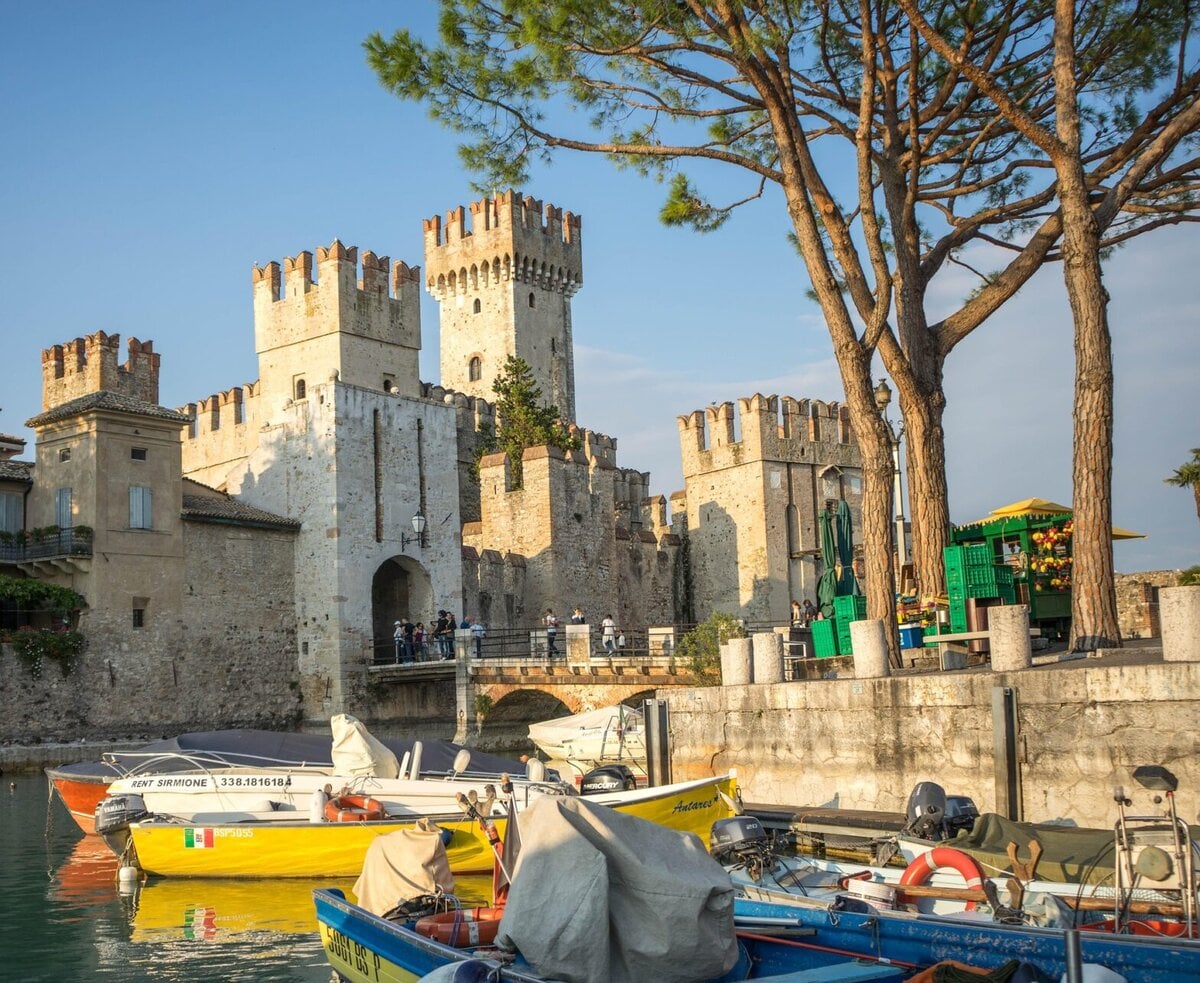
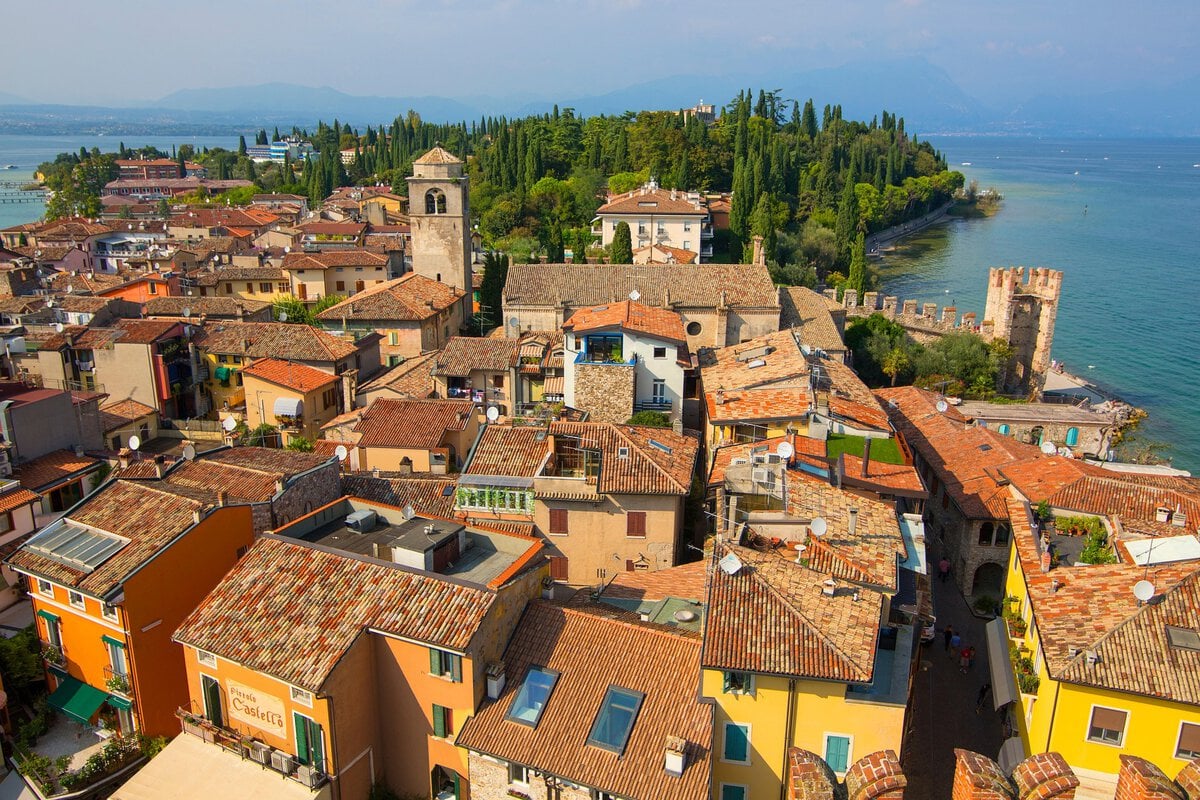
Sirmione juts into the lake on a narrow peninsula 6–10 km from Desenzano (10–20 minutes by car, 20 minutes by ferry).
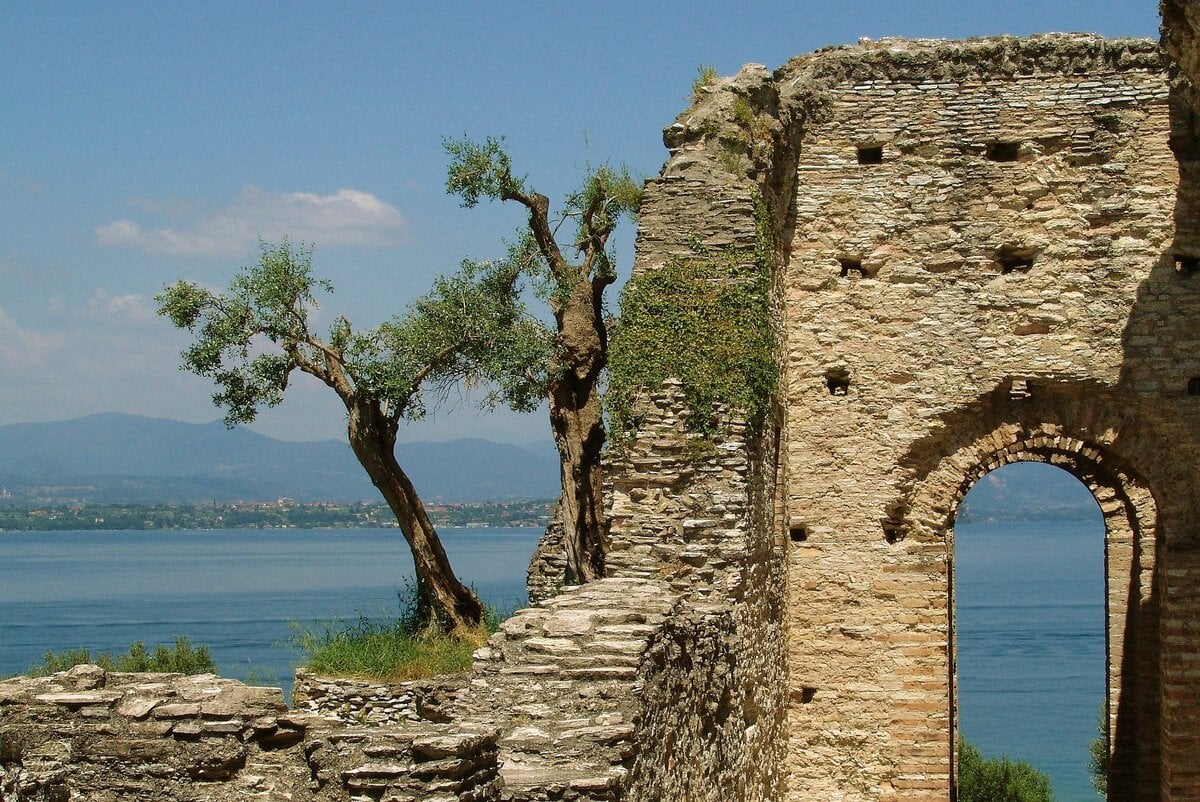
At its tip, the Grotte di Catullo — not caves, despite the name, but the ruins of a grand Roman villa covering two hectares amid an olive grove of 1,500 trees — sit above water that shifts between turquoise and deep blue depending on the season. Named after the poet Catullus, who praised Sirmione in his verse, the villa was likely built after his death for the Gens Valeria family.
Entry is €10 (reduced €2, free under 18). A combined ticket covering the Grotte, Sirmione’s Scaliger Castle, and Desenzano’s Villa Romana costs €14–20.
Summer hours run 08:30–19:30 (closed Tuesdays).
The Terme di Sirmione draws on the Fonte Boiola, a sulphurous thermal spring that emerges at 69°C from 20 meters below the lake bed after filtering through rock from Monte Baldo for approximately 20 years. The Aquaria spa facility offers indoor and outdoor thermal pools (34–36°C), saunas, Turkish baths, and an infinity pool overlooking the lake, with full-day admission running approximately €50–75.
Near the Boiola pumping station, a small informal pool of thermal overflow water is free and open to anyone — bring a towel and arrive early.
Jamaica Beach at Sirmione’s tip, with its smooth white rocks and clear water, is a regular lake beach (not thermal) and is free to access.
Dining, Markets, and Where to Stay in Desenzano
Desenzano’s Tuesday market (08:00–13:00) stretches along the Lungolago Cesare Battisti and ranks among the lake’s largest, known for discounted fashion alongside local produce and cheese.
The Porto Vecchio dining scene centers on the medieval harbor, where restaurants offer terrace seating directly over the water. Budget meals in the area start around €17–22; mid-range lakeside dinners with wine typically run €30–50 per person.
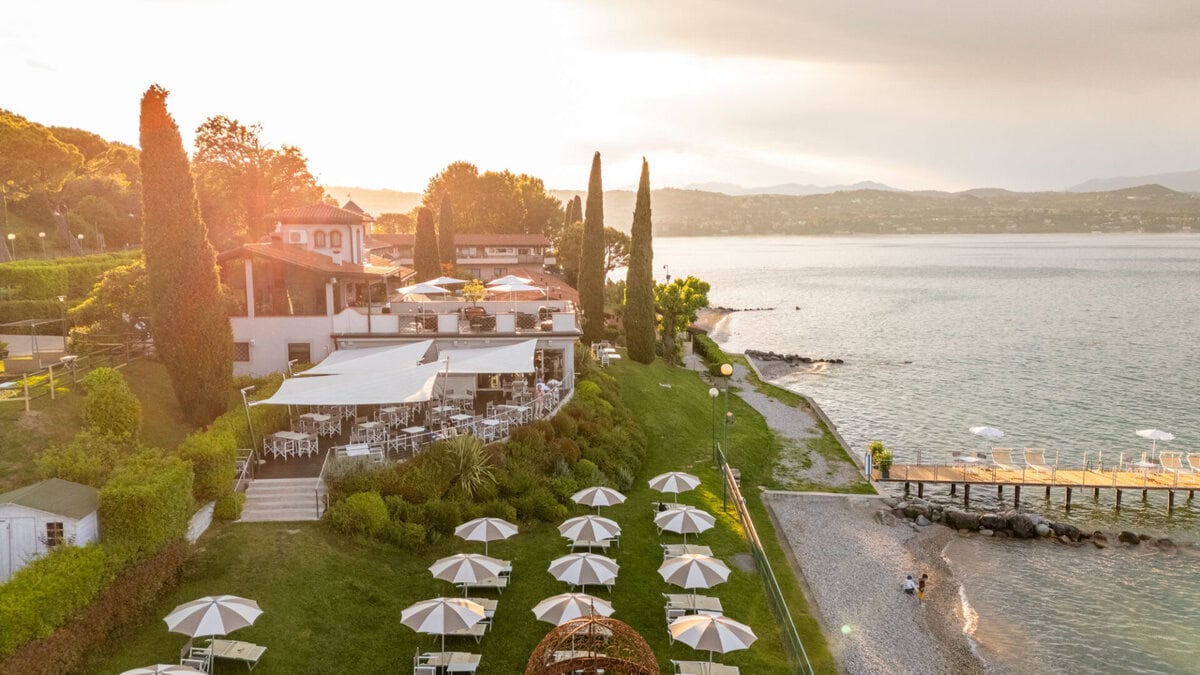
For couples and smaller groups seeking a more design-led open-air accommodation, Club del Sole’s Desenzano Boutique Resort is a great choice and it’s around 2 km to get to the town center. The property offers suites, lodges, and lakefront apartments, a heated panoramic pool, a private beach, and a restaurant. It targets a more upscale aesthetic than the family-oriented properties on the eastern shore, and its proximity to Desenzano’s train station makes it a practical base for day trips to Verona, Venice, or Brescia.
The Northern Trentino Shore: Wind, Cliffs, and Suspended Paths
The landscape changes completely as you travel north. Hills give way to rock faces that drop vertically into water that turns from green to deep turquoise.
Riva del Garda, at the lake’s narrow northern tip, sits where surrounding mountains channel thermal winds with near-daily regularity.
Two winds define the cycle: the Pelér, a north wind that builds from midnight and peaks at sunrise (typically 3–5 Beaufort, sometimes exceeding 25 knots), and the Ora, a south thermal wind that arrives around noon and peaks by 15:00 at 15–25 knots. The Pelér’s flat morning water suits beginners; the Ora’s afternoon builds challenge experienced riders.
This predictability makes the northern lake one of Europe’s most reliable windsurfing and sailing destinations.
Riva’s Piazza III Novembre opens directly onto the lake, surrounded by arcaded buildings that blend Italian and Austro-Hungarian architecture — a reminder that this was Austrian territory until 1918.
The 13th-century Torre Apponale rises 34 meters; its 165 steps lead to a panoramic terrace crowned by a weather vane that has become the town’s symbol.


The Ciclopista del Garda: Cycling Between Cliff and Lake
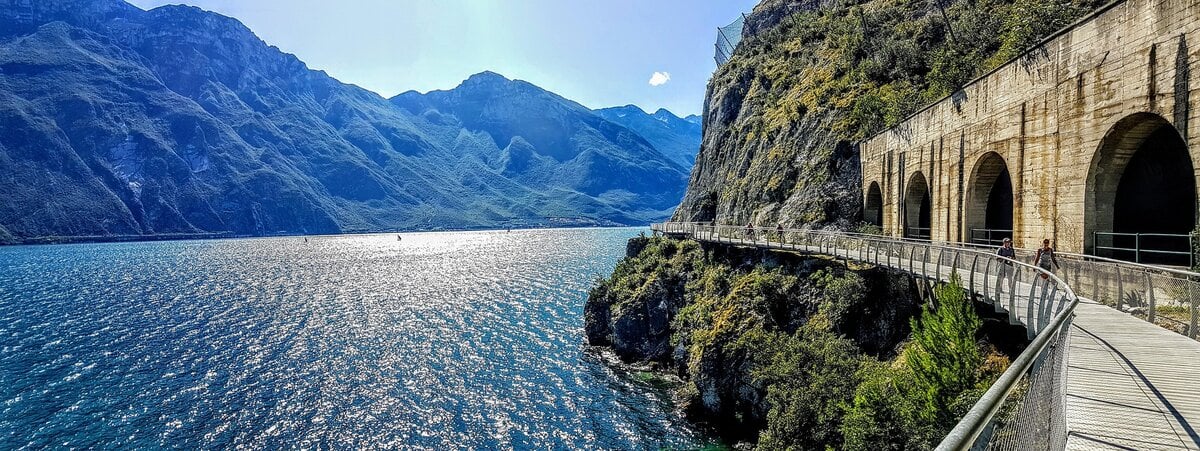
The Ciclopista del Garda at Limone sul Garda, inaugurated in July 2018, is roughly 2–2.5 km of cantilevered pathway anchored to cliff walls by steel sleepers, hovering approximately 50 meters above the lake surface. It is free to use, open 24 hours year-round, with LED lighting for nighttime use and a 10 km/h speed limit for cyclists. In March 2025, a new 1 km section opened connecting Riva del Garda southward toward Limone, carved through rock. The path forms part of the larger Ciclovia del Garda project to eventually encircle the entire lake.
Limone itself preserves its famous limonaie — architectural lemon houses with stone pillars and wooden beam covers dating from the 13th century, built to protect citrus trees that have no business growing this far north. The restored Limonaia del Castèl contains over 100 citrus varieties (entry €2).
Cliff-Face Hiking and the Monte Baldo Cable Car
The Sentiero del Ponale, a former military road carved into cliff faces between 1848 and 1851, runs from Riva del Garda toward Lake Ledro. The main viewpoint at Ponale Alto Belvedere is about 3 km and 1.5–2 hours return, with the full route to Pregasina stretching 5 km one way.
The Busatte–Tempesta trail between Torbole and Tempesta features 400 metal steps suspended from rock faces across three dramatic staircases — the longest, Corno de Bò, has 238 steps with open views in every direction — covering 4 km one way in about 1.5 hours at easy-to-moderate difficulty. Both trails rank among northern Italy’s most spectacular for the ratio of effort to reward.
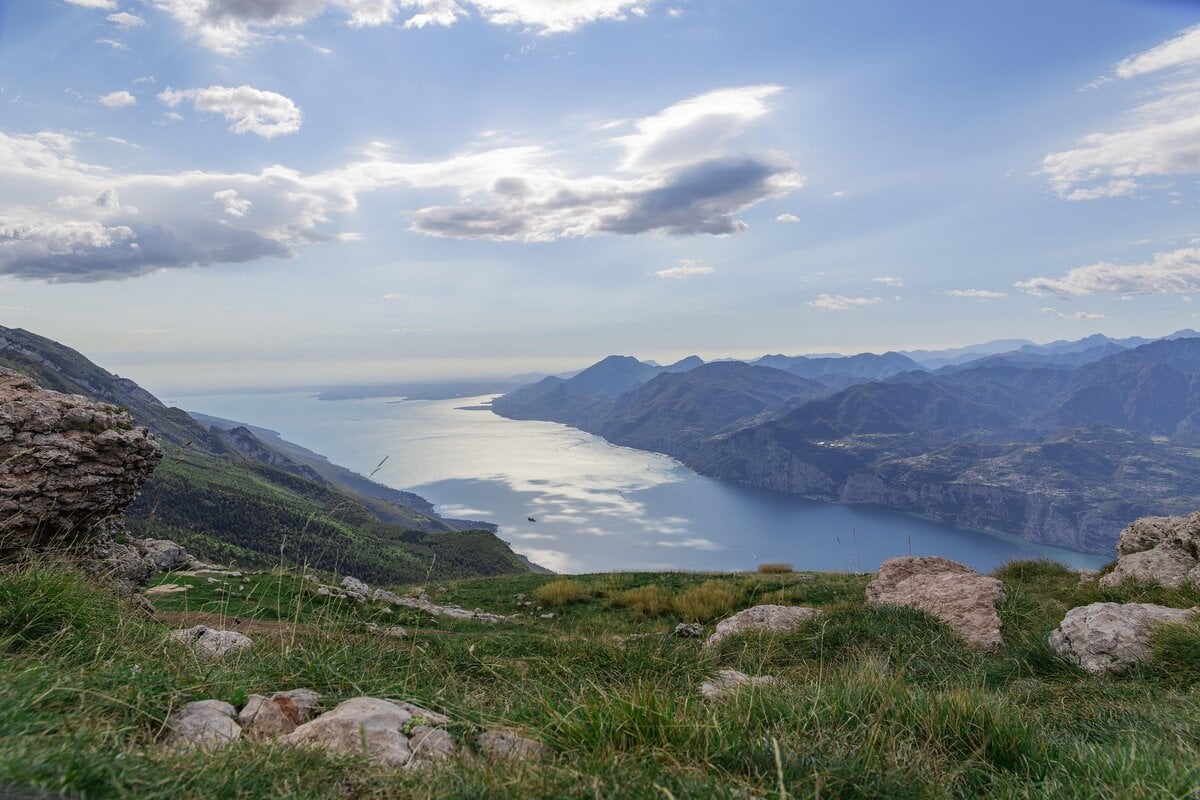
The Funivia Malcesine–Monte Baldo lifts passengers from lake level to 1,760 meters in about 20 minutes. The upper cabin makes a full 360° rotation during ascent, carrying up to 80 passengers. From the summit, clear-day views stretch across the full 52 km length of the lake to the Dolomites. Activities at the top include paragliding (Monte Baldo is one of Europe’s most popular launch sites), ridge hiking, and botanical walks — the mountain is known as the “Garden of Europe” for its exceptional endemic flora.
Adult round trip: €30 (€28 online), one way €22 (€20 online).
Season: Early April – early November, first ascent 08:15, last 18:00.
Practical Information
Getting around the lake
Navigazione Lago di Garda operates 30 boats — motorships, hydrofoils, catamarans, and car ferries. The main route connects Desenzano to Riva del Garda with stops at most lakeside towns, taking roughly 5 hours on regular service or 2.5 hours by hydrofoil (€6 surcharge).
The Maderno–Torri del Benaco car ferry operates year-round, crossing in about 30 minutes. Single tickets range from €3.50 to €17.50 depending on distance. Whole-lake day passes cost €39.50 adults (2026); three-day passes are €79.
Timetables and tickets: navigazionelaghi.it.
Best time to visit
May, June, and September offer the ideal balance: warm days (mid-20s °C), manageable crowds, and full ferry and attraction schedules.
July and August bring peak heat (30°C+), peak crowds, and accommodation premiums of 20–30%. Lake water reaches swimmable temperatures of 22–27°C from July through September.
April and October are pleasant for hiking and cycling, with cooler evenings.
Getting there
Verona Villafranca Airport (VRN) is the closest airport, 24 km from Lazise and 30 km from Desenzano. Milan Bergamo (BGY) is 80 km west.
By train, Desenzano–Sirmione and Peschiera del Garda are both on the Milan–Venice line: Verona 15–20 minutes (€5–6), Milan approximately 50 minutes (from €12), Venice approximately 1 hour 20 minutes by high-speed (from €12).
ATV buses connect train stations to lakeside towns not on the rail line.
Day trips
Verona is 15–20 minutes by train from Desenzano or Peschiera — close enough for a half-day trip to the Arena and Juliet’s house. Venice is reachable in under 1.5 hours by high-speed train. Brescia, home to the UNESCO-listed Santa Giulia museum, is under 20 minutes by regional train from Desenzano.
Typical costs
Espresso: approximately €1.20.
Gelato: €2.50–4.
Aperitivo spritz: €5–8.
Budget restaurant meal: €12–18. Mid-range lakeside dinner with wine: €30–50.
City bike rental: €10–25/day. E-bike rental: €40–80/day.
Frequently Asked Questions
How many days do you need at Lake Garda?
A minimum of four to five days allows time for two shores plus a day trip north. A full week lets you cover all three shores at a comfortable pace, with time for a vineyard visit, a Sirmione day, and a ferry crossing. Weekend trips work if you stay at one base — Desenzano for transport access, Lazise for families.
Can you get around Lake Garda without a car?
Yes. The Navigazione Lago di Garda ferry system connects most lakeside towns, with frequent service from April through October. Desenzano and Peschiera have direct rail connections. ATV buses fill the gaps to towns not served by ferry or train. E-bike rentals make the flat eastern shore easy to cover independently.
Is Lake Garda suitable for young children?
Very much so. The flat cycling paths on the eastern shore accommodate strollers and child trailers. Gardaland and Caneva Aquapark are within minutes of Lazise. The southern shore’s pebble beaches have gentle entries, and ferry rides between towns are engaging for kids. Many family-oriented camping villages and holiday parks offer pools, playgrounds, and kids’ entertainment.
What is the Ciclopista del Garda and is it open?
The Ciclopista del Garda (also called the Garda by Bike path) is a cantilevered cycle and pedestrian path anchored to cliff walls between Limone sul Garda and Riva del Garda, hovering about 50 meters above the lake. It is free, open 24/7 year-round, and a new 1 km section toward Riva del Garda opened in March 2025. A speed limit of 10 km/h applies to cyclists.
Are the thermal baths in Sirmione worth visiting?
The Terme di Sirmione’s Aquaria spa offers thermal pools fed by naturally hot sulphurous water (69°C at the source, cooled to 34–36°C in the pools) with views across the lake. Full-day entry runs €50–75 depending on the package. For a free alternative, a small informal thermal overflow pool sits near the Boiola pumping station at the peninsula’s tip — arrive early, bring your own towel, and expect minimal facilities.
When is the best time to ride the Monte Baldo cable car?
Arrive early in the morning (first ascent at 08:15) for the clearest views and the shortest queues. Mid-week visits are significantly quieter than weekends. The cable car runs from early April through early November; an adult round trip costs €30 (€28 online). The upper cabin rotates 360° during ascent, so every position has a view.